"Persistence" is moving ahead
resolutely, despite interference, opposition, importunity or
warning.
|

One of the
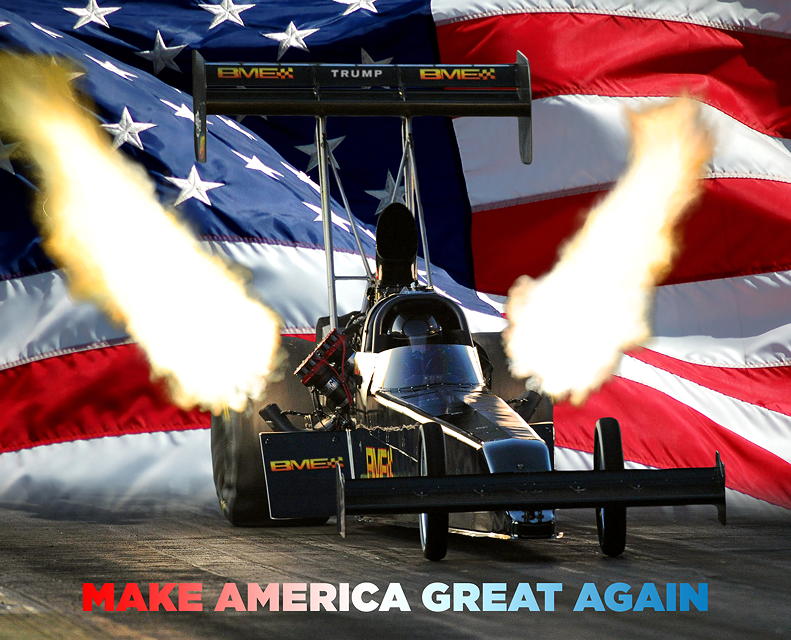
last competitive, self-sponsored racers in Top Fuel
drag racing is Carson City, Nevada's Bill Miller. Image: BME
Ltd. |
Persistence,
above all, keeps the Bill Miller Engineering/Okuma/Red Line Oil
Top Fuel Dragster Team competing in the National Hot Rod
Association's Full Throttle Drag Racing Series.
Calvin Coolidge, 30th U.S. President, was famous for his views
on the subject: "Nothing can take the place of persistence.
Talent will not–nothing is more common than unsuccessful men
with talent. Genius will not–unrewarded genius is almost a
proverb. Education will not–the world is full of educated
derelicts. Persistence and determination are omnipotent. The
slogan 'press on' has solved and always will solve the problems
of the human race." |
Prominent
in the Bill Miller Engineering race trailer is a plaque bearing
Coolidge's words. Every member of the BME Race Team takes them to
heart.
|
A rarity in a motorsport where teams with two or three
racecars, a dozen spare engines, three tractor trailers,
scores of full-time crew members and millions of dollars in
sponsorship are the norm, Bill Miller is the last true
independent in Top Fuel drag racing. He races 15 Full
Throttle Drag Racing Series events each year, mostly out of
his pocket with the rest made-up by machine tool
manufacturer, Okuma America; premium lubricant maker, Red
Line Oil along with Autolite Spark Plugs, Sandvik Coromont
and Infinity Rebuild. Miller's Top Fuel operation is a
single car, a highly-motivated crew of three full-time and
seven part-time members and a budget dwarfed by those of the
National Hot Rod Association's nitro class stars. |
 |
|
The BME/Okuma America Top Fuel Dragster blasts down Pomona
Raceway on a qualifying pass at the 2004 NHRA Winternationals.
Image: Autoimagery.com |
|
|
 |
|
Asked how he manages to run a Top Fueler with a small crew and
limited financing, Bill Miller will quickly answer,
"Persistence. It's not talent, not genius, not education..
it's persistence." Image: BME Ltd. |
|
Why does Bill Miller race a Top Fuel Dragster? He and his
Team are consumed by the engineering challenges of racing
supercharged, nitromethane-burning dragsters. Each crew
member craves the competition and excitement of NHRA's top
class. Miller, also, views racing as a team-building
experience for his employees, several of whom are on the BME
crew. Last, but certainly not least, Bill Miller Engineering
uses its dragster to develop, test and promote its products:
BME Forged Aluminum Racing Pistons, BME Wrist Pins, BME
Forged Aluminum Connecting Rods and the Gibson/Miller Mark
II Supercharger.
"Just recently,"
Bill Miller said in an Spring-2009 interview, "we went in
production with the Mark II version of the blower. The
changes we made to it were directly a result of what we've
learned racing the car in the last few years. Then, we used
the car, mostly last season, to validate the new design.
Several years ago, we changed the connecting rod and that,
too, was a direct result of racing the car. The durability
of our rods is about three times more than the previous
design. That makes a big difference to racers who use the
BME Rod. We continually upgrade the pistons and the pins, as
well. And, it's not only just racing the car. Because we're
at the track and talk with guys who run my parts, we get
continuous feedback about things to improve.
|
We are,"
Miller states, "the only manufacturer of pistons, pins, connecting
rods and superchargers which runs its own race car in an effort to develop
and test products and to stay current."
 |
|
Tim Gibson at the wheel of the old BME dragster at the
Winternationals in 2001.
Image:
BME Ltd |
|
 |
|
Once upon-a-time, Bill Miller raced a Chevrolet-powered Top Fuel
Dragster. For many years, it was the only blown Fontana/Chevy on
fuel at National Events.
Image: BME Ltd |
|
Bill
Miller has been a regular competitor in drag racing's ultimate class for
a quarter century and he was persistent from the start. For 17 years and
in two different cars he ran the only blown, Fontana/Chevy on
nitromethane at National Events, but at the end of '98, economics
finally trumped persistence. With the cost of staying competitive with
the Chevrolet out of control; he put a Keith Black Hemi in his eight
year-old chassis. Eventually the KB-powered version of the "old" BME car
went its quickest, 4.59-sec., with Tim Gibson driving, at the '01 U.S.
Nationals. At its final event, the '03 World Finals, it ran its fastest,
323 mph, with David Grubnic at the wheel.
 |
|
Another of the reasons Bill Miller races a Fueler is it's a
rolling test and validation tool for his line of aluminum
connecting rods, racing pistons and wrist pins. Here Miller,
himself, examines a set of BME Rods which came out of the engine
in the BME Top Fuel car.
Image: BME Ltd |
|
|
 |
|
Bill Miller makes all the tuning decisions on
his Top Fueler. Like all professional drag race teams, the
BME/Okuma/Red Line Oil Dragster has an on-board, multi-track
data recording system. The data it stores on each run is the
lynch pin of the tuning process. One of a blown-fuel tuners many
tasks is making sense out of the myriad of data each drag strip
pass provides. Here, Bill Miller, reviews a pass from the '08
Winternationals in the BME race team trailer's lounge. Image:
BME Ltd. |
|
|
In 2004, Miller debuted a new car which played a key part in the
Team's best ever performance in the '06 season and saw the start
of a two-year run for '03 Top Alcohol Champion, Alan Bradshaw,
as BME's driver. The Team ran 13 events, set best-ever e.t. and
speed, 4.545/326.32 mph, and finished 15th in points. The
high-point came at Chicago in June. Bradshaw qualified the BME
car 16th. He beat No. 1 qualifier and World Champion, Tony
Shumacher, in the first round and took out J.R. Todd in the
second before losing to Melanie Troxel in the semis. Of T/F
teams running partial schedules, Bill Miller Engineering
finished best behind 14 full-time, touring pros. "2006 was a
very good year," Owner/Crew Chief Miller told BME Blogger,
Rick Voegelin. "Finishing 15th in the Championship after
competing in less than 60 percent of the races was quite an
accomplishment. It's a testament to what can be done by an
enthusiastic and talented team of volunteers who put their
hearts and souls into Top Fuel racing." For more on '06, see
the BME Blog. |
|
 |
|
This is most of the BME/Okuma Top Fuel Team.
It's a small, closely-knit and experienced group of people who
work together and communicate very well. They are preparing the
BME/Okuma/Red Line Dragster for its third qualifying run at the
'08 Winternationals. Image: BME Ltd. |
|
If 06
was great, 07, well...it kinda sucked. Much of the season was spent
on development and testing of the Gibson/Miller Mark II
Supercharger. The new blower is a better performer than all other
Roots superchargers used in drag racing. Any big change to a Top
Fuel tune-up results in a temporary lack of consistency and such a
problem plagued the BME Team's blower program for a while. The
newfound, but difficult to manage power from the Gibson/Miller Mk II
blower not only affected engine tuning but aerodynamics as well.
"The motor's making more power." Bill Miller said. "Because
the car accelerates so hard, it lifts the front end off the ground
in the early part of the run. There's no steering with the front
wheels in the air, so the driver either keeps his foot in it if the
car goes straight or shuts off.
|
 |
|
The BME/Okuma/Red Line Oil Team just prior
their second qualifying run at the '08 Winternationals. They've
just started the engine and are making a few adjustments prior
to Troy Buff's rolling forward for a burnout. Image: BME Ltd. |
|
The only thing keeping the front wheels on the ground is
the aerodynamics of the front wing. Yeah, there's a drag
penalty later in the run, but that won't negate the wing's
benefit early in the run. A Top Fuel pass is 4.5 seconds. To
half-track, is 3.1 of those seconds. That's 70% of the e.t.
spent in the first half of the race track. Once you get past
150-175 miles an hour, you can't react fast enough. That
happens at about 250 feet, so the car has to be going
straight prior to that. Anticipating this problem, in the
off-season, we changed the front bodywork to a full-width
front wing rather than the two canards we had before. That
extra downforce will keep the front wheels on the track." |
Not
directly affecting BME's performance, but certainly affecting that of
other teams was the type of metal tubing used in Top Fuel and Funny Car
chassis. The heat-treated vs. normalized (or "Condition N") tubing
debate simmered during the last half of '06, but broke wide-open in
2007. A hint of this came in a article about the BME Team in the January
2007 issue of Drag Racer magazine. Bill Miller's over thirty
years of experience in metallurgy had him a critic of the NHRA's
"heat-treated tubing rule", enacted after the failure of the U.S. Army
Top Fueler's chassis at Seattle in '05. Miller told Drag Racer
correspondent, Hib Halverson, in interview for the article, the change
"...didn't make the sport safer; it made it more dangerous.
Heat-treating makes the chassis brittle. Instead of having a ductile
failure, where a tube bends; it fractures. There's no warning you're
approaching the limits of the part; it just suddenly breaks. The
Schumacher car at Seattle, last year, was a ductile failure. The bottom
rails broke because they were too small, but the top rails bent, because
they were not heat-treated, and the chassis stayed together. The failure
McClenathan had this year ('06) at Bristol in a heat-treated
chassis, was a classic, brittle fracture. Parts snapped and the car came
apart."
|
Nine months later, failure of a heat-treated chassis
possibly killed Eric Medlin and, then, six months after
that, another failure may have almost killed John Force.
Those tragic events made the heat-treated vs Condition N
tubing controversy a high-profile issue throughout drag
racing. Bill Miller Engineering and the BME Top Fuel Team
were instrumental in scientific research done to prove the
detrimental effects of using heat-treated tubing in a race
car chassis. While the story in the January Drag Racer
was not investigative, an article by drag racing journalist,
Jon Asher, posted in October of '07 on
Competitionplus.com and in January of '08 on this web
site, was investigative and is the truth about Top Fuel and
Funny Car Chassis Failures. Please click here to read this
BME Special Report.
During '07, Mark II Supercharger development and the
distraction and tragedy brought-on by the heat-treated
chassis problem which plagued the whole sport of drag
racing, resulted in seven DNQs for the team, its worst
season in many years. The best of the worst came in June at
the Route 66 Nationals where Alan Bradshaw qualified the BME
Fueler 12th with a 4.550 but then lost in the first round to
Doug Herbert. At the World Finals the car went 324 mph.
Unfortunately, the Team was unable to run that quick and
fast on a regular basis. For more on the '07 season, see the
Blog. |
 |
|
The BME car uses an 8000-hp Brad Anderson
Hemi. Atop the BAE Hemi is the Gibson/Miller Mark II
Supercharger. Image: BME Ltd. |
|
|
 |
|
Now here's a picture right out of science
fiction movie. Because nitromethane exhaust is not so good to
breathe, when the team warms-up the motor in the pits, they all
don these gas masks. The guy just to the right of driver, Troy
Buff, is Car Owner. Bill Miller. Image: BME Ltd |
|
2008 was a huge turnaround for BME. Bill Miller, true to his
tradition of hiring successful blown alcohol drivers, signed
former TAD racer and second generation dragster driver, Troy
Buff, to drive the famed, black-and-yellow, BME/Okuma/Red
Line Oil racecar. Buff, who, in '06, put down the quickest
and fastest T/F licensing pass in NHRA history, then spent a
year at the wheel of the Coghlan Motorsports fueler, brings
three things to BME. First, he weighs less. The rule of
thumb in Top Fuel is: each 15 lbs out of the car is a
hundredth off the e.t. In a class were wins can depend on a
thousandth of a second, 20 pounds less in the driver seat is
huge. Second, Troy Buff already is Top Fuel savvy, having
driven for the Coghlans. Lastly, a dragster gearhead since
childhood, Buff is a perfect addition to a team where
everyone, even the driver, works on the car.
|
 |
|
EVERYONE on the
team works on the car between runs...even the driver. Troy Buff's
tasks are supercharger maintenance, care and mixing of the
90% nitromethane fuel and parachute packing. Here, he's
fitting the drive assembly to the BME Dragster's
Gibson/Miller Mark II Supercharger. Image: BME Ltd. |
|
|
 |
|
Perhaps the most
labor intensive part on a blown-fuel car is the clutch.
Any fuel team has a dedicated "clutch guy" and many teams
have more than one person working on clutches. On the
BME/Okuma Team, Ed Litke is the clutch expert. The Team has
half a dozen clutches and it's a full time job to "rebuild"
them after each run. Here Ed uses an air grinder and an
abrasive disc to refinish a clutch pressure plate. Image:
BME Ltd |
|
During
the '07/'08 off-season, the BME Dragster was "re-back-halfed" at BME's
shop, returning to its pre-mid-'06 configuration, which used Condition N
or "normalized", rather than heat-treated, 4130 Chromoly tubing. New
front bodywork was built which provided more front downforce. Of the
Gibson/Miller Mk II, Bill Miller says, "The new blower increases
airflow into the engine. As a result, we had to increase the fuel flow
but, for the first six-or-seven races (in '07) I was not prepared
for the amount of fuel that it took to keep the motor from backfiring.
The Mark II is better than any blower I've had on the dyno. The fuel
flow requirement for the engine with a Mk II on it has gone up
dramatically. In fact, to get more fuel into the motor, Kent Enderle and
I designed a new type of down nozzle. That's another thing I've been
testing and they work really well."
|
 |
|
Troy Buff in the BME Dragster rockets off
the Pomona starting line on its third qualifying pass at the
'08 Winternationals. At left center, wearing his trademark,
yellow ball cap and holding his radio headset so it won't
get blown off, Bill Miller, intently watches. Image: BME
Ltd. |
The
improvements paid off generously in 2008. The team qualified for all 15
of the 25 events it entered. It went to the second round three times and
ran a best of 4.603/308.28 mph during the first half of the season on a
1/4-mile track, and 3.840/309.27 in the second part which was run to
NHRA's new Pro class standard, a 1000-foot track. The high-point of the
season was the last race, the NHRA World Finals at Pomona where BME
qualified 14th then squared off with Hillary Will, No. 2 in the world at
the time, in the first round. Troy Buff dispatched Will with his
career-best 3.840/309.27 mph, dropping Will from second to fourth in the
final rankings and giving the BME Team a 14th place finish for the year,
the second time in three years, BME had the highest finish for any NHRA
Top Fuel team running a partial schedule. For more on BME's '08 season,
see the Blog.
Of late, for Bill Miller Engineering,
drag racing is like the stock market: volatile. After a great 2008, '09
started out pretty rough for the team with a DNQ at the rain-fouled
Winternationals, a weekend that not only BME, but just about any drag
racer who entered the event would agree what NHRA should have renamed it
"Waternationals". As of mid-season, BME has qualified at every race it
entered but has been unable to get past the first round. Going forward,
the Team wants to finish the new race car it has under construction as
soon as possible. This will be the first car built entirely by Bill
Miller Engineering and it will be race ready for the last part of the
season.
Bill Miller owns the Team, leads it and
works on the car, himself. The BME Race Team aren't quitters nor do they
look for the easy way to success. Each crew member has a task crucial to
the team's success. "When you look at the mountain we have to climb,"
Bill says of the Team's challenge, "which is to be competitive in Top
Fuel; it's a tough climb for a crew of three full-time guys and seven
part-timers, competing against crews of 10 to 12 working full-time. But,
we have the right parts. We've got virtually the same engine set-up as
the full-time pros. Our new car will have all the current chassis
technology. There's a psychological effect, too. The entire team's
attitude bolstered by the state-of-the-art equipment we're running."
|
 |
|
Troy Buff heats the tires on
BME's only qualifying pass at the rain-plagued, 2009
Winternationals. If the bad weather wasn't enough, at the
end of the burnout, a driveline failure ended the BME Team's
weekend.
It was a tough break and a somber beginning to the '09 Full
Throttle Drag Racing season. The good news is the rest of
the year can only get better. Image: BME, Ltd. |
What's
Miller's secret to being Top Fuel competitive on a budget that's about
15% of what most touring pros in the nitro class spend? Bill told
Drag Racer magazine, "I work my ass off. Also, I'm careful with
the money I have. With some teams, a tremendous amount of money gets
wasted. Also, because I'm in the rod and piston business, I talk to my
customers, many of whom are nitro class racers, all the time. We talk
about the car, motors, clutches and everything about Top Fuel racing. I
pick-up a tremendous amount of valuable information that way.
"At this
point, Bill Miller Engineering and Okuma America put-up most of the
money. We're, also, pleased to have Goodyear, Autolite/Fram, ARP, XRP,
Infinity Rebuild, Sandvik Coromant and Red Line Synthetic Oil
Corporation helping us out. We're going to keep our schedule to about 15
or 16 races in 2009."
If you go
to an NHRA National Event and you want to meet some of the last
independents in Top Fuel stop by the BME/Okuma/Red Line Oil trailer.
During
your visit, you'll no doubt learn a little bit about persistence.
|
The BME
Bulletin
Find out more details of recent BME/Okuma Top Fuel Team
history by reading our bulletins from 2004-2008. Written by
veteran drag racing writer, Rick Vogelin, this collection covers
most of the NHRA National Events the Team has entered in those
five years. You'll find race results, comments by Team Owner,
Bill Miller and BME driver, Troy Buff, along with other topics
of interest.
CLICK HERE TO READ THE BULLETIN: |
|
 |
|
The BME/Okuma/Red
Line Oil Top Fuel Team at Pomona in February of 2008.
Left to
right are: Mr. Bill, Ron Hixson, Troy Buff, Scott Bowen, Bill
Miller, Larry Wolyniec, Adam Schultz, Ryan Blaire, Robert
Howard, Ed Litke and Ed Litke Jr. These guys are the hardest working
crew in Top Fuel. Stop by the
BME trailer at a National Event and watch them prepare the BME/Okuma/Red
Line Oil Dragster |
|